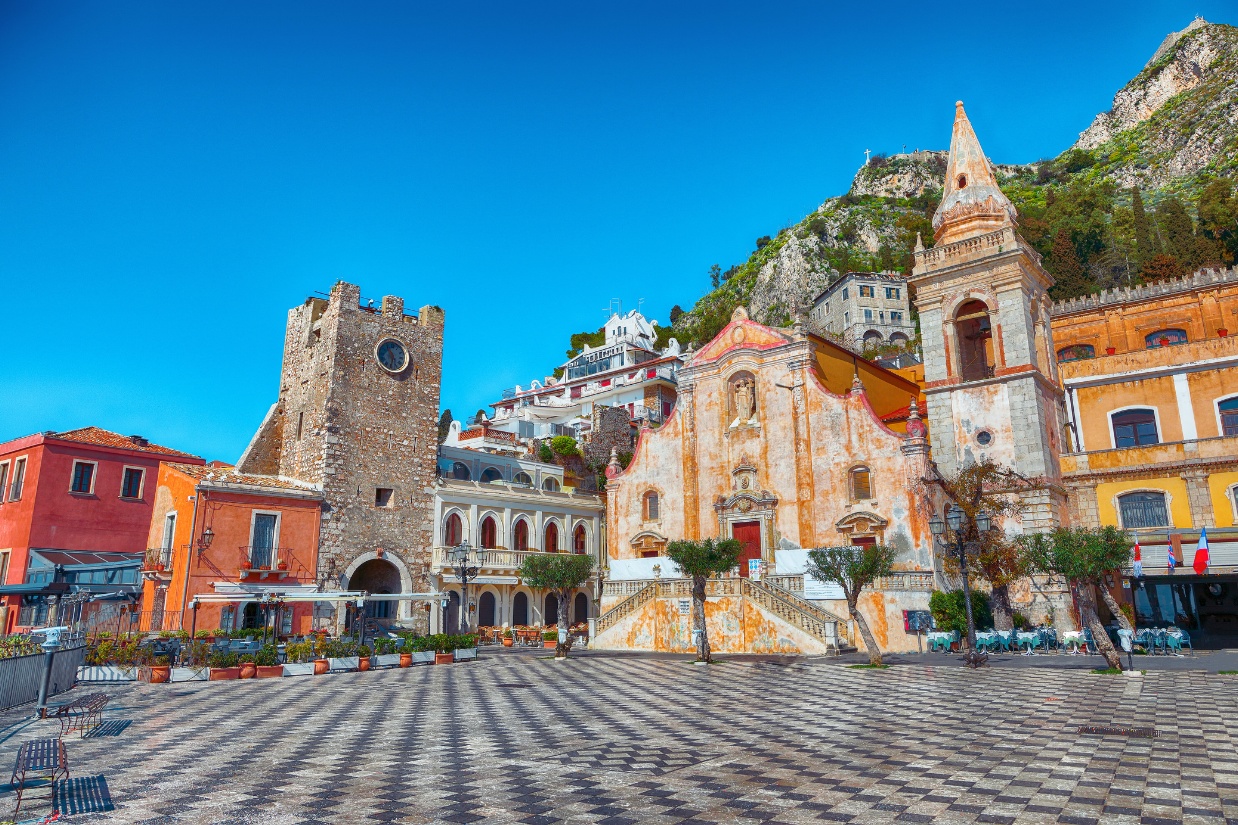
Finding your bearings in the city, to experience beauty without improvisation
In this microcosm suspended between sea and sky, Taormina is not something you pass through—it is something you choose. Where stone preserves the memory of centuries and terraces seem designed to train the eye toward infinity, nothing is neutral. Every decision—where to stay, when to go up, what to avoid—shapes the way the city reveals itself. Here, time does not rush; it stratifies.
Luxury in Taormina does not coincide with display. It is access: to places that speak softly, to perspectives that elude the crowds, to choices that respect the place’s deeper nature. It is knowing when the city is a stage and when it becomes a refuge. It is about subtraction rather than addition.
This article is for those wondering where to stay in Taormina, when to go, and how to avoid the wrong choices without forcing the city’s natural rhythm.
It is written for those who seek not ostentatious luxury, but a quieter one—rooted in history and in the living material of place, shaped by discreet access, the right timing, and details that change everything without drawing attention to themselves. For cultured travellers, attentive to aesthetics and context, who value orientation over instruction.
In recent years, Taormina has become a contemporary myth. The series The White Lotus has projected the San Domenico Palace into the global imagination, turning it into a recognisable symbol even for those who have never set foot in Sicily. At the same time, an elite European clientele continues to experience Taormina as a discreet retreat: baroque gardens preserved in silence, terraces withdrawn from view, and a daily life shaped by details that escape the most visible narratives.
Between these two souls—exposure and discretion—there is a delicate balance. Those seeking privacy must learn to read the calendar: spring and early autumn offer the city at its most harmonious; winter, often overlooked, reveals a more contained, essential Taormina, capable of transforming one’s perception entirely. Summer need not be ruled out, but it requires targeted choices and a precise understanding of timing, access and pauses.
Once you arrive, it is essential to let go of the checklist mindset. Taormina does not open itself to those who accumulate stops. Its value emerges in the slow rhythm of its lanes, in the way light shifts across stone, in the awareness that an aperitif chosen at the right moment can hold more meaning than three forced visits. This is not about seeing everything, but about feeling the place. Taormina is not only a destination: it is a state of mind. It asks you to slow down, to breathe with it, not to consume—but to inhabit.
Taormina as a place to inhabit, not simply to visit
Taormina demands precision. And attentiveness. It is not a place to pass through: it is a presence to synchronise with. The key word is awareness—few movements, the right timing, addresses chosen with care. To inhabit Taormina is to recognise the value of pauses, to accept that not everything needs to be seen, and that much—here—reveals itself only to those who know how to wait.
It means choosing a place that resonates with your inner language; planning a walk at sunset, when the streets begin to empty and the stone releases the day’s warmth; lingering over lunch at a family-run table of tradition, letting the scent of pistachio and oregano accompany time, unhurried.
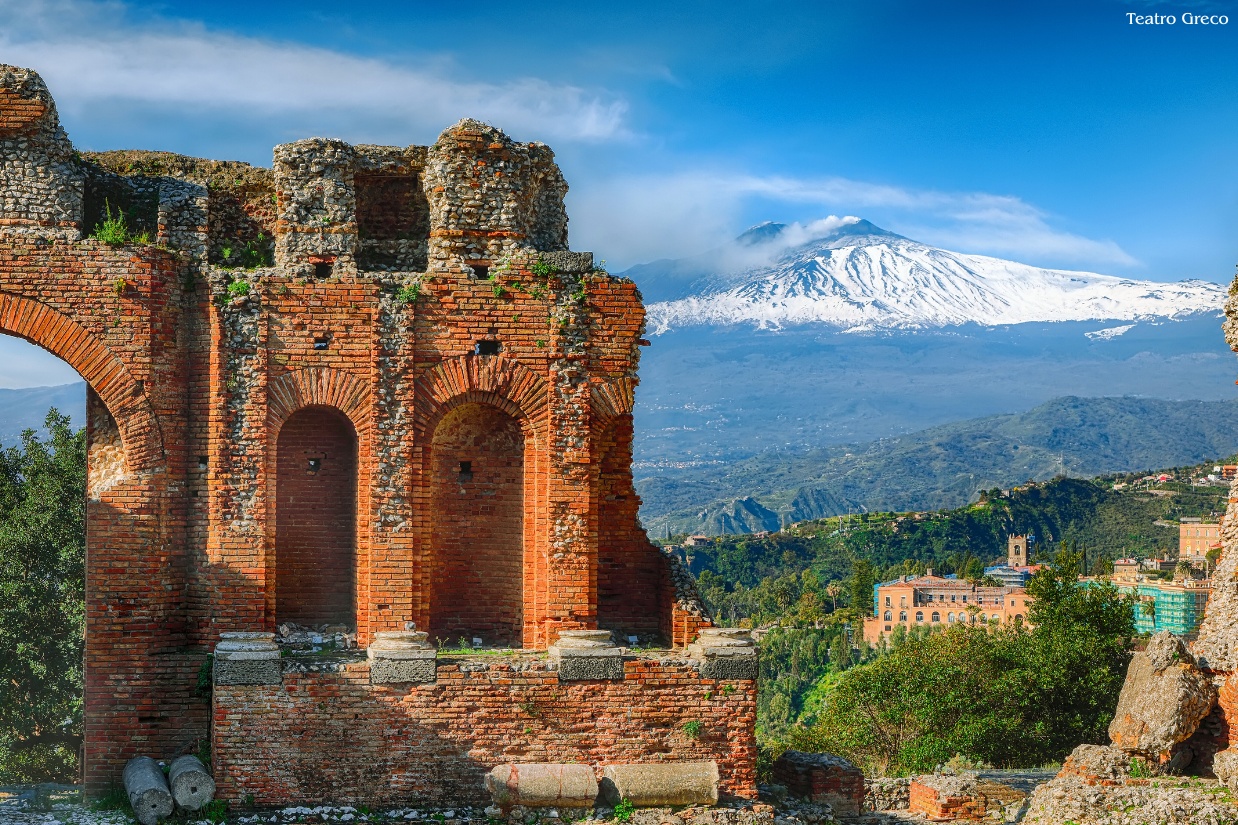
Above all, inhabiting Taormina means refusing to conform. The historic centre can turn into a crowded showcase, yet one side staircase is often enough to bring you to a quiet garden with sea views. The city rewards those who know how to waste time well: sitting on the Literary Terrace at the Belmond Grand Hotel Timeo and watching the theatre’s profile framed by columns; crossing the Ancient Theatre outside peak hours, when the echo of footsteps becomes part of the landscape; climbing toward the castle at first light, as the Ionian coast slowly ignites.
You don’t need to do a lot. You need to do it well.
Coffee: the luxury of the right pause
In Taormina, coffee is not a parenthesis—it is a gesture of measure. Places like Bam Bar, informal and authentic, where the ritual feels almost domestic—a well-made granita, a brioche that smells of morning, and that small, spontaneous brightness you cannot manufacture—work best when the city is still light. And then Caffè Wunderbar, facing the square like a natural stage: here the pause becomes contemplation, an espresso taken slowly as the light changes and Taormina steps into the scene without asking anything of you. These are not stops to add, but pauses that help you read the city without forcing it.
Choosing where to stay in Taormina: a question of identity
In Taormina, accommodation is not a logistical detail: it is a statement of identity. Each address offers a different way of inhabiting the city—of looking at it, moving through it, allowing it to unfold. There is no universally “best” choice, only a choice that is more coherent with what you seek—and with what you would rather avoid.
Deciding the setting: historic centre or sea
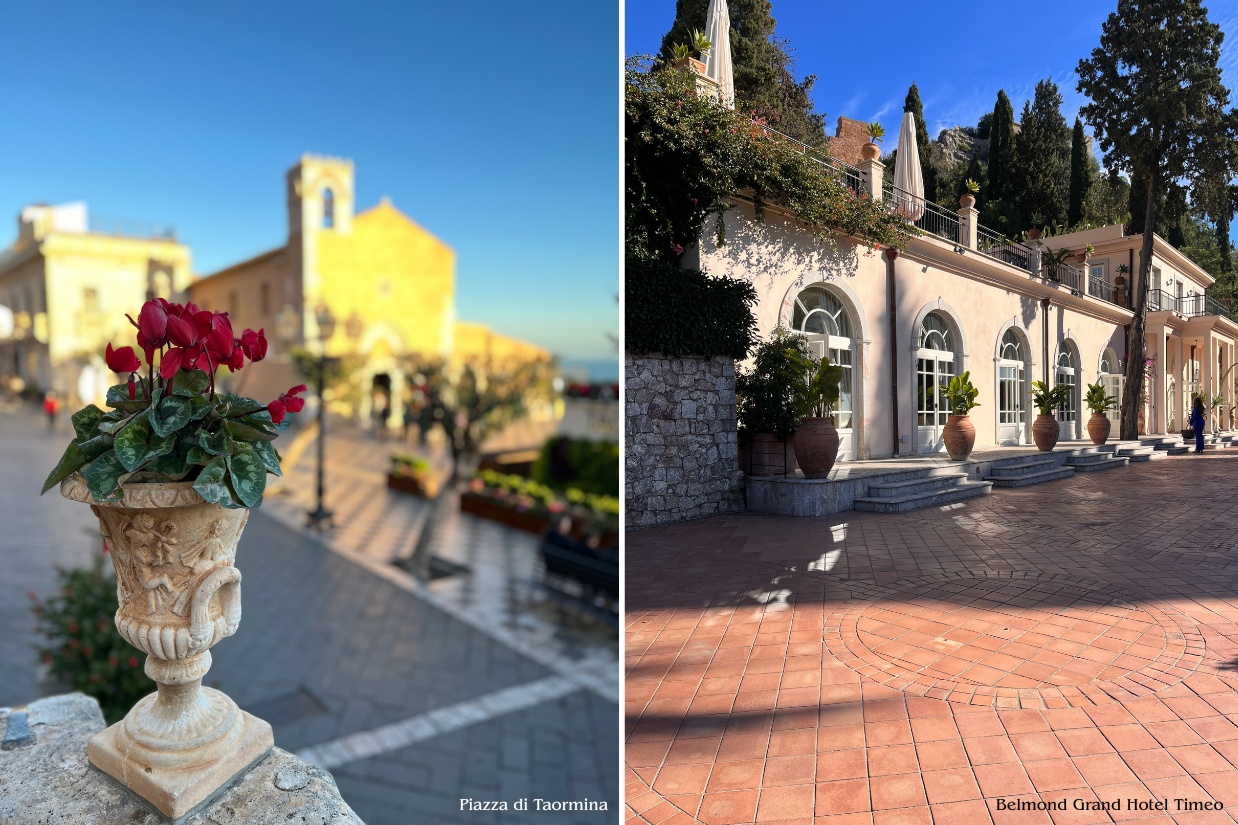
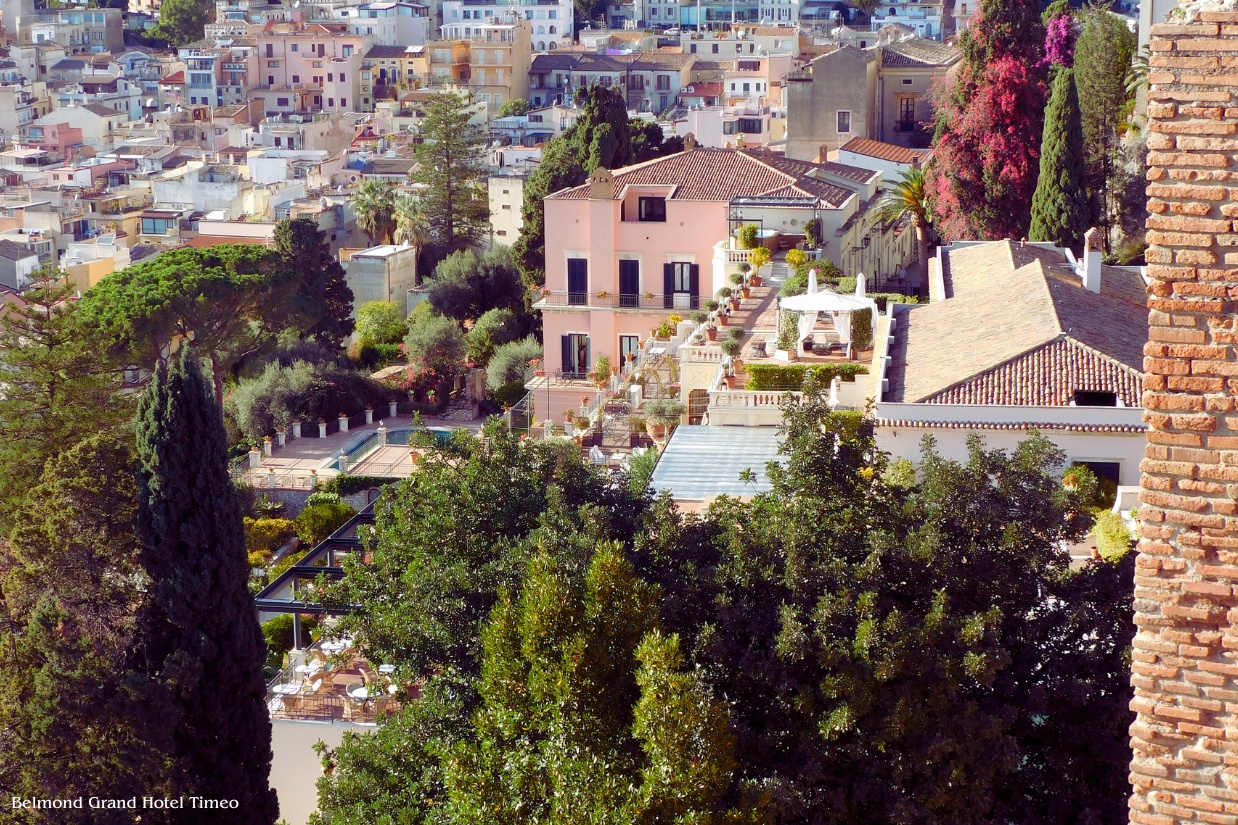
Staying in Taormina’s upper historic heart means living its most iconic image: the Greek Theatre in front of you, Etna on the horizon, gardens cascading toward the sea. Here you find residences that embody the city’s historic elegance—such as the Belmond Grand Hotel Timeo, with its timeless grace, and the San Domenico Palace, a former convent transformed into an exclusive retreat. For those who prefer a more intimate atmosphere, yet equally panoramic, there are boutique hotels such as The Ashbee, where the view becomes a quiet, everyday presence.
Those who want the sea as a constant companion may choose the shoreline of Mazzarò or Isola Bella. The natural reference here is Villa Sant’Andrea, with its private beach and the ease of alternating sea days with the city’s social life. For those who prefer to remain above, without giving up the gaze over the water, addresses such as Villa Carlotta or Hotel Metropole offer gardens and panoramic pools that allow you to contemplate the sea without leaving the city behind.
The criterion of history and character
In Taormina, hotels are not simply places to sleep: they are chapters in a story still unfolding. To choose them is to decide which narrative you wish to enter. The Belmond Grand Hotel Timeo, the city’s first hotel, inaugurated in the nineteenth century, has hosted writers, distinguished travellers and figures of international cinema; the San Domenico Palace combines the monastic austerity of an ancient convent with a contemporary glamour that has entered the collective imagination.
To stay in these residences is to accept their character. Some historic rooms preserve intimate proportions—sometimes contained, even shadowed—while others, especially in newer wings, offer generous terraces and private pools, ideal for those seeking seclusion and absolute privacy. Knowing these differences is part of the choice: here, charm is not standardised, but layered.
Those drawn to a more contemporary language may gravitate toward boutique hotels such as The Ashbee or Villa Carlotta, where essential design and hushed atmospheres help you step away from the crowds without surrendering the sea view. In places like these, luxury is measured in discretion—and in the continuity of silence.
Villas and private residences
For those who require total freedom, Taormina offers an even more private dimension: villas and private residences. Here, space becomes part of the experience. Homes such as Villa Don Mimì Guarnaschelli, with its six suites, centuries-old park and infinity pool overlooking Isola Bella, or Villa Sparviero, among the area’s most evocative locations, with dedicated chef and driver services, answer the desire for absolute privacy and truly bespoke hospitality.
Alongside these residences—already known for their character and setting—there are also villas that work when a home is not merely “where you sleep,” but a way of inhabiting Taormina without fragmenting it. Mediterranean Sundae, for instance, is designed for those who seek light and breathing space: generous rooms, outlooks that invite you to slow down, and a layout that protects the rhythm of a stay. Bay of Bliss, by contrast, speaks a quieter, more contained language: an ideal choice when luxury coincides with the absence of interference—with time flowing without the need to be filled.
These options are ideal for families, groups of friends, or travellers who wish to inhabit Taormina without intermediaries—managing time and rhythm with complete autonomy. Yet even more intimate properties can become charming retreats: places such as Relais 147 show how modest dimensions, private terraces and a hidden garden in the heart of Corso Umberto can offer an experience that feels intimate and deeply coherent, particularly for couples and solo travellers.
Selected hotels: when they make sense, and for whom
The San Domenico Palace is a former convent transformed into a contemporary icon. Its cloisters and gardens carry centuries of history, while more recent imagery has turned it into a global symbol. It is the natural choice for those seeking a scenic, almost cinematic dimension—who enjoy feeling the city’s pulse around them. Some rooms in the historic wing retain more contained, austere proportions; the newer suites, especially those with private pools, offer seclusion and absolute comfort. It speaks to travellers who collect memorable, visual, iconic experiences.
The Belmond Grand Hotel Timeo embodies a different idea of centrality. It is the city’s grand dame, overlooking the Greek Theatre, with a terrace that alone justifies the journey. Here, glamour is organic and layered, never ostentatious. Rooms and suites in the main building deliver the most complete experience; the Villa Flora annex, while elegant, feels more discreet and slightly removed. It is the ideal address for romantic travellers and for lovers of history, literature and panoramas meant to be contemplated in silence.
Those who prefer a more intimate atmosphere may gravitate toward boutique hotels such as The Ashbee, where refined design and the scale of the spaces make guests feel more like residents than clients, or toward addresses such as Villa Carlotta and Hotel Metropole, which combine historic character, panoramic gardens and attentive yet never intrusive service. These choices work particularly well for longer stays, when Taormina stops being spectacle and becomes everyday life.
This selection reflects Sicily Luxury’s criterion: only places capable of offering something genuinely extraordinary—an authentic story, an unrepeatable view, a service you hardly notice but long remember. Not to multiply options, but to avoid compromise.
Experiences worth your time (and why)
In Taormina, the value of an experience is not measured by the number of activities, but by the quality of time it gives back. A memorable journey grows out of a few well-calibrated choices, placed at the right moment of the day—when the city softens its tone and allows itself to be inhabited.
Some experiences work because they are in dialogue with the place itself. A thoughtfully paced dinner at a historic table is worth more than a sequence of restaurants to “tick off.” An evening walk through the centre, when groups thin out and the stone still holds the day’s warmth, offers a truer sense of Taormina than any compressed guided tour.
The sea, when chosen with care, becomes part of the narrative. Heading out by boat early in the morning or at sunset, away from crowded routes, allows you to see Taormina from its quietest side. Even a simple aperitif can turn into an experience when placed in the right setting, at the right hour—when the view stops being a backdrop and becomes a presence.
Culture here works through subtraction. Visiting the Ancient Theatre outside peak hours, accessing it privately or crossing it slowly, without overlapping commentary, restores a rare sense of intimacy. In the same way, stepping into a historic residence usually closed to the public, guided by someone who truly knows its story, adds depth without weighing the stay down.
These are not activities to accumulate, but moments to place. Introduced with restraint, they become emotional layering; forced, they turn into noise.
Experiences that only work if done well
Not every experience suits every traveller, and not every experience works at all times. In Taormina, more than elsewhere, how matters more than what. Standard proposals—group visits, crowded tours, serial tastings—risk trivialising even the most extraordinary places.
Entering the Ancient Theatre in the middle of the day, when the flow never truly stops, means giving up contemplation. Even an excellent dinner, if wedged into an overloaded day, loses its meaning.
The difference lies in orchestration: choosing the right hour, reducing the number of stops, avoiding overlaps. Preferring reserved access to an experience shared with too many others. Relying on someone who knows the city’s timing, not only its addresses.
This is where the journey changes pace. When experiences stop being things to “do” and become things to live at the right moment, Taormina gives back what makes it unique: a beauty that will not reveal itself to those in a hurry.
If the goal is to shape a coherent stay—aligned with your rhythm, interests and personal style—the right support is not there to add, but to remove: to avoid random choices, out-of-context experiences, overloaded days. In other words: choose better, not do more.
Restaurants: two tables worth an evening
In Taormina, dinner is not an appointment—it is a decision. If you choose to turn it into a ritual, do it properly:
Otto Geleng, intimate and finely calibrated, where restraint is part of the experience; and
La Capinera, a Michelin star by the sea, for those who want Sicilian cuisine interpreted with precision and impeccable direction. These are not names to collect, but places that only work when placed on the right evening.
Rhythm, seasons, right timing and wrong timing
Taormina changes face with the seasons—but even more with the way it is experienced. There is no single “right” moment in absolute terms: there are coherent timings, and timings that betray the experience.
Spring and early autumn are the most balanced seasons. The light is soft, the air carries the scent of citrus blossom, and the historic centre becomes readable again. Walking through the lanes in April is to feel the city breathe; in September, the tempo slows and terraces regain a more intimate scale. These are the periods when Taormina reveals itself without defence.
Summer is not to be ruled out, but it must be interpreted. It works only if you accept a life of subtraction: going out early in the morning, retreating during the central hours, re-emerging as the sun lowers. A sunset walk, an aperitif chosen with precision, a late dinner away from the main flows can still deliver an authentic beauty, despite the crowds.
Winter is the secret season. Fewer visitors, clear skies, a sharper light on stone. Taormina becomes quiet, almost introspective. It is the ideal time for those seeking contemplation: getting lost in the gardens of the Villa Comunale, watching the sea from an empty bench, reading on a terrace without feeling the need to do anything else.
There are, however, also wrong timings. Arriving without reservations in the heart of summer; visiting the city’s symbolic places at peak hours; assuming that an evening in the historic centre follows a single script. Taormina does not favour disorderly improvisation. It rewards those who know how to synchronise their pace with the light, with silence, with pauses.
Reading the city’s rhythm is not a logistical detail—it is part of the experience. It means choosing when to stop, when to go out, when to remain. In this delicate balance, the city ceases to be scenery and becomes a presence.
Taormina does not ask to be conquered.
It asks for attention.
It is a city that reveals itself through layering, not accumulation: a place where beauty does not explode, but endures. It endures in stones that change colour with the light, in the silences between one lane and the next, in the measured gestures of those who have learned not to force time. Here, the most common mistake is not choosing poorly—it is choosing too quickly.
It means planning in order to leave space, deciding so that you can breathe, entrusting yourself to the place’s natural rhythm instead of imposing your own. In this subtle balance, Taormina stops being scenery and becomes presence.
Because here, the difference between a successful visit and an experience that stays with you is not the quantity of things done, but the quality of the decisions made.
And Taormina, when chosen with care, never disappoints.
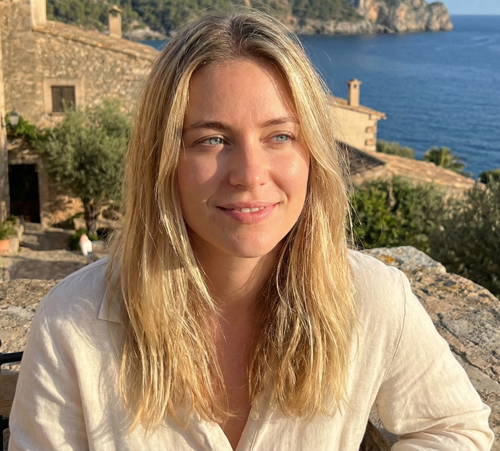
I’m Olga, one of the editorial voices behind Sicily Luxury.
Based in Sicily, I contribute to the curation of bespoke stays and itineraries for international travelers.
For enquiries and contact: IG @olga.insicily
For more Sicily notes, follow our Telegram channel: Sicily Luxury