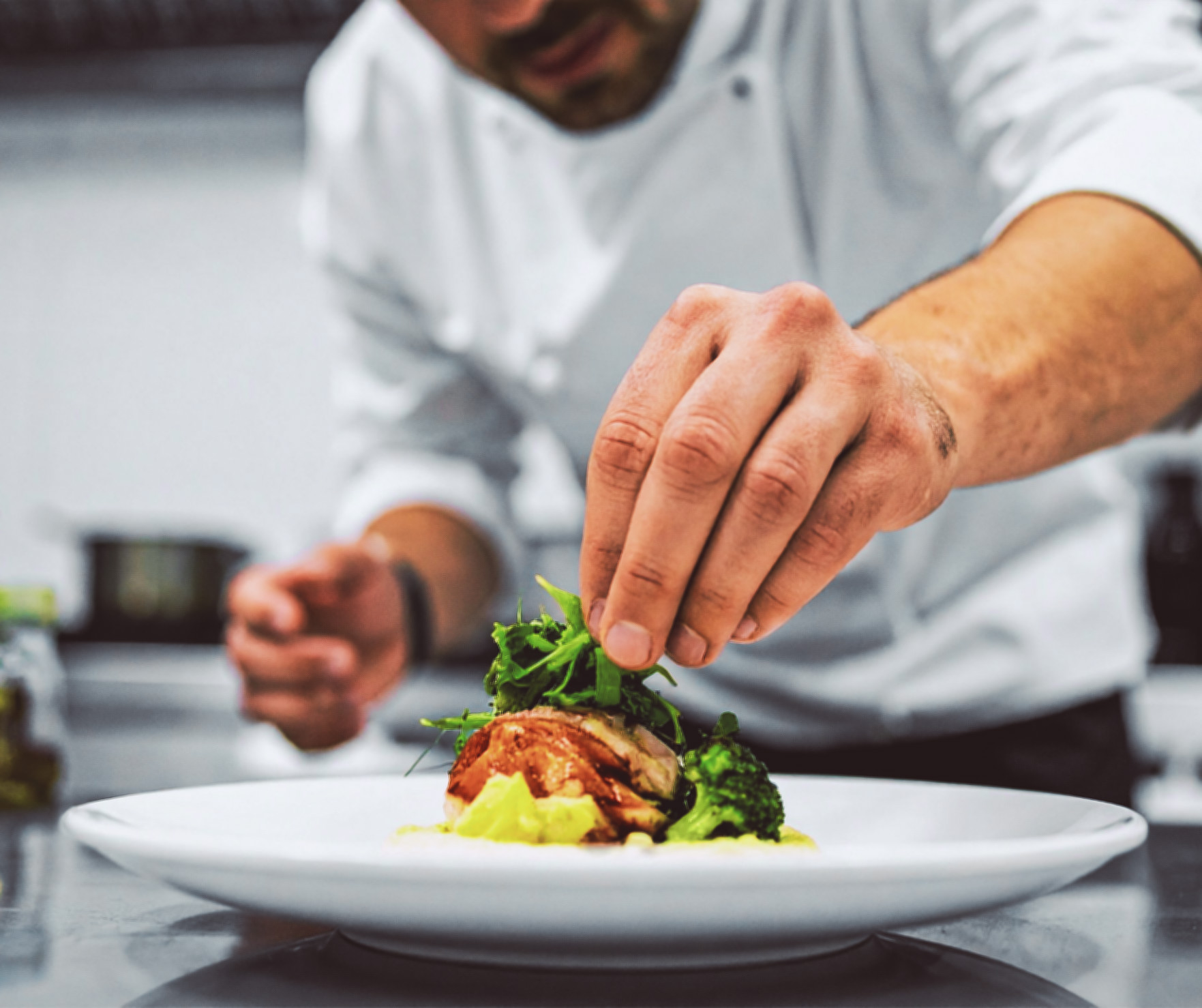
Four hours in a Sicilian kitchen with a chef, a small group and the time it actually takes to work the dough with your own hands.
You prepare, you taste, you correct. Then you sit down to a table made of what you cooked together.
This is not a show-cooking demonstration. It is a private Sicilian cooking class with a chef, for travellers who want to understand the island through its ingredients, its gestures and its recipes rather than only through its monuments.
Sicilian cooking is not a regional variation of what is served as Italian food abroad. It is its own kitchen, and much of what makes it distinctive — the sweet-and-sour balance, the almonds, the citrus, the ricotta, the wild fennel — belongs to the island rather than to the peninsula.
The group is made up of two to six people from the same booking. Keeping the number small allows the chef to follow each person's work directly and preserves the participatory character of the class.
It takes place in a well-equipped, welcoming kitchen — the chef's own, a restaurant or a selected residence — where the chef already knows the space and the equipment. That is an essential condition: every guest needs room to work without interruption.
Tell us where you will be staying in Sicily, and the class is built around your destination. Sicily Luxury receives the request and verifies the chef's availability, the venue, the date, the number of guests, the language and any dietary requirements before confirmation.
Here you do not watch someone cook. You cook.
That is the whole difference. The chef works alongside the group throughout the preparations, shows each step and explains why a recipe behaves the way it does.
How long to work a dough. When to add an ingredient. How to recognise the right texture. Why the same dish changes from one part of Sicily to another.
No previous experience is required: the class is designed for taking part, asking questions and trying things directly. That is also the criterion behind the menu — every guest must have something to do in each of the preparations.
It begins with the ingredients · about 30 minutes
Before the stove come the products. The chef presents the day's menu and the chosen ingredients, explaining their season, their character and their relationship with the land. Sicily does not offer the same cooking all year round, and that is one of the more interesting things to discover: what is on the table in March is not what is on the table in September.
Then you cook · about 2 hours
The heart of the experience. You work with the chef on a few selected preparations, chosen so that everyone can take part, each with a station and a defined task. The chef explains the reasoning behind the gestures and corrects your hand while you work.
And finally, the table · about 1 hour
When the work is done, you sit down. Lunch or dinner is composed of the dishes made during the class, with the drinks indicated in the proposal. It is the moment when what was an ingredient on the worktop a few hours earlier becomes part of a meal. If you choose the evening, expect Sicilian hours: dinner here begins later than in most of northern Europe.
Farewells and recipes · about 15 minutes
The last questions, the advice for making the dishes again at home and the substitutions for ingredients that are difficult to find outside Sicily — sheep's milk ricotta and durum wheat semolina among them. The recipes of the day are sent in writing after the class, in English or in Italian, with quantities in metric measures.
What you might prepare
We do not propose an identical menu for every class. The choice is defined according to the season, the venue, the availability of ingredients and the preferences of the group. Fresh pasta, vegetables, fish, ricotta, citrus, almonds, pistachio and aromatic herbs enter the menu depending on the area and the time of year.
The menu is not a list to be completed. The criterion is the opposite one: few preparations, and enough time to understand them properly. If there is a Sicilian dish you would like to learn, mention it when you write: the chef will consider it according to the season and the technical time it requires.
Sicilian tradition, read with a contemporary eye
The cooking starts from Sicily. Not, however, from a fixed and immobile idea of tradition.
It helps to know what is underneath it. Greeks, Arabs, Normans and Spaniards each left something in these kitchens: citrus and sugar, the taste for sweet-and-sour, almond pastry, the aubergine, the saffron. Sicilian cooking was layered long before Italy existed as a country, and that is why a caponata can taste closer to the eastern Mediterranean than to Rome.
A recipe can be lightened, revisited through different textures or accompanied by ingredients that bring out particular characteristics. Without chasing effect for its own sake: the reference to the territory must remain recognisable.
It is this balance that makes the experience interesting even for guests who already know cannoli, caponata or pasta alla Norma by name, and would like to go beyond tasting them.
Would you like to start at the market?
These are two versions of the same experience. What changes is where the ingredients come from, and therefore how long the day lasts.
Class and table · about 4 hours
The standard format. The ingredients have already been selected by the chef and the day begins in the kitchen. This is the version that works best for travellers with a single free half-day.
Market, class and table · about 5 to 6 hours
When the location, the day and the opening hours allow it, the class can be preceded by a visit to the market with the chef. You look at what is available, choose some of the ingredients and understand the relationship between season, territory and menu far better than any explanation can convey.
Every Sicilian market has its own character, and none of them resembles a food hall arranged for visitors. For this reason the route is built around the destination and the availability of the moment, rather than repeating the same programme everywhere.
Lunch or dinner
The class can end with lunch or with dinner. The market format depends on the days and opening hours of the stalls, which are generally active during the morning; availability and programme are verified for the chosen destination.
We’ll prepare a tailor-made proposal.
Tell us your dates, how many you are and where you’re staying. No commitment: we check availability and conditions with our partner.
Request a proposalAn experience built around your journey
Tell us where you will be in Sicily. We build the cooking class around your destination.
The class can be arranged in different parts of Sicily, according to the availability of the chef and the venue and the logistics of the destination.
This matters more than it may appear on a map. Sicily is a large island, and the distance between one coast and the other is measured in hours of driving: a class chosen for its location rather than for your own would cost you most of a day of your holiday.
The menu, too, comes from the place. Ingredients and preparations can differ between western and eastern Sicily, between the coast and the inland towns, following the season and what the local producers actually have.
The aim is not to carry an identical format around the island, but to let the territory genuinely enter the experience.
Before you book
The group is only yours
The class is private: all participants belong to the same booking, from two to six people. You are never grouped with other guests, as happens in scheduled cooking courses.
Allergies and dietary requirements
Intolerances, allergies, vegetarian diets and other requirements must be communicated in advance, not on the day itself: some of them change the entire menu and need to be agreed with the chef.
The language is confirmed beforehand
The class is held in English or in Italian, with the chef or with a person who accompanies the guests throughout. The requested language is verified together with availability, so that nothing of the explanation is lost in translation.
You work standing, and you will get messy
Two hours at the worktop, with flour, vegetables and open flames. It is worth arriving in comfortable shoes and in nothing you are particularly fond of.
The desired location should be indicated in your enquiry: venue, chef and format are verified for that destination and confirmed in the proposal. In specific cases a private venue may also be considered, subject to verification of the space and the equipment.
The proposal you receive before confirmation clearly states the duration, the programme, an indicative menu, the included services, the venue and the price.
What the experience may include
Unless otherwise indicated, the experience does not include transfers to and from the venue of the class, accommodation, drinks not agreed in advance, personal purchases at the market in the longer format, and any service not expressly stated in the proposal.
Who this class is designed for
You do not need to know how to cook. You only need to want to take part. Travellers who are looking for the pleasure of a Sicilian meal without putting their hands in the dough will find a better answer in one of the experiences indicated further down this page.
How the class takes shape
Tell us your dates
Date, area of Sicily, number of participants, language and any dietary requirements. Indicate also whether you prefer the standard format or the one with the market.
Verification
The chef's availability, the venue, the compatibility with the number of participants and, in the longer format, the market day are all checked.
A tailored proposal
You receive a solution with the duration, the programme, an indicative menu, the venue, the services provided, the conditions and a dedicated quotation.
Confirmation of the details
Once approved, the time, the address of the kitchen, the operational contacts and the practical information for the day are defined.
Enquire about your Sicilian cooking class
Tell us where you will be staying in Sicily and we will build the class around your destination. A few details are enough: date, area, number of participants, language and any dietary requirements. Let us know whether you prefer the standard format or the one that begins at the market — and if there is a recipe you have always wanted to learn, tell us about it.
Alternatively, contact us directly
Useful clarifications
Do we really cook together with the chef?
Yes. It is a participatory class: guests take a direct part in the preparations, each with a station and a task. The chef guides and corrects, but the work is done by the participants.
How is this different from the Private Chef Experience?
They are two opposite experiences. With the Private Chef, the centre is a meal prepared for you: the guests neither cook nor travel anywhere. In the cooking class the value lies in taking part — learning a few steps, cooking alongside the chef and then sitting down at the table.
Is the class held in English?
Yes, when requested in advance. The class is held in English or in Italian, either directly with the chef or with a person who accompanies the guests for the whole duration. The language is confirmed together with availability.
Do we need to know how to cook?
No. The pace and the preparations are adapted to the experience of the group. It is useful to mention in advance if someone has never cooked or, on the contrary, already has solid practice.
Is the menu always the same?
No. It depends on the season, the venue, the ingredients available and any dietary requirements. What stays constant is the structure — a vegetable preparation, a pasta, a dessert — not the list of dishes.
Can we visit the market?
Yes, when the destination, the day and the opening hours allow it. In that case the experience lasts approximately five to six hours and the route is defined according to the market available in the chosen location.
Other selected experiences
Private Chef Experience in Sicily
The meal and the service at your own location, with no travelling and no cooking. It is the complementary proposal to this one, for guests who would simply like to sit down. View the experience →
Private Road Trip in Sicily
If your destination is not a single one: a tailor-made self-drive itinerary, along which the cooking class can find its place. View the experience →
A Sicilian recipe is not learned by reading it.
It is learned by doing it, correcting a gesture and understanding why.