
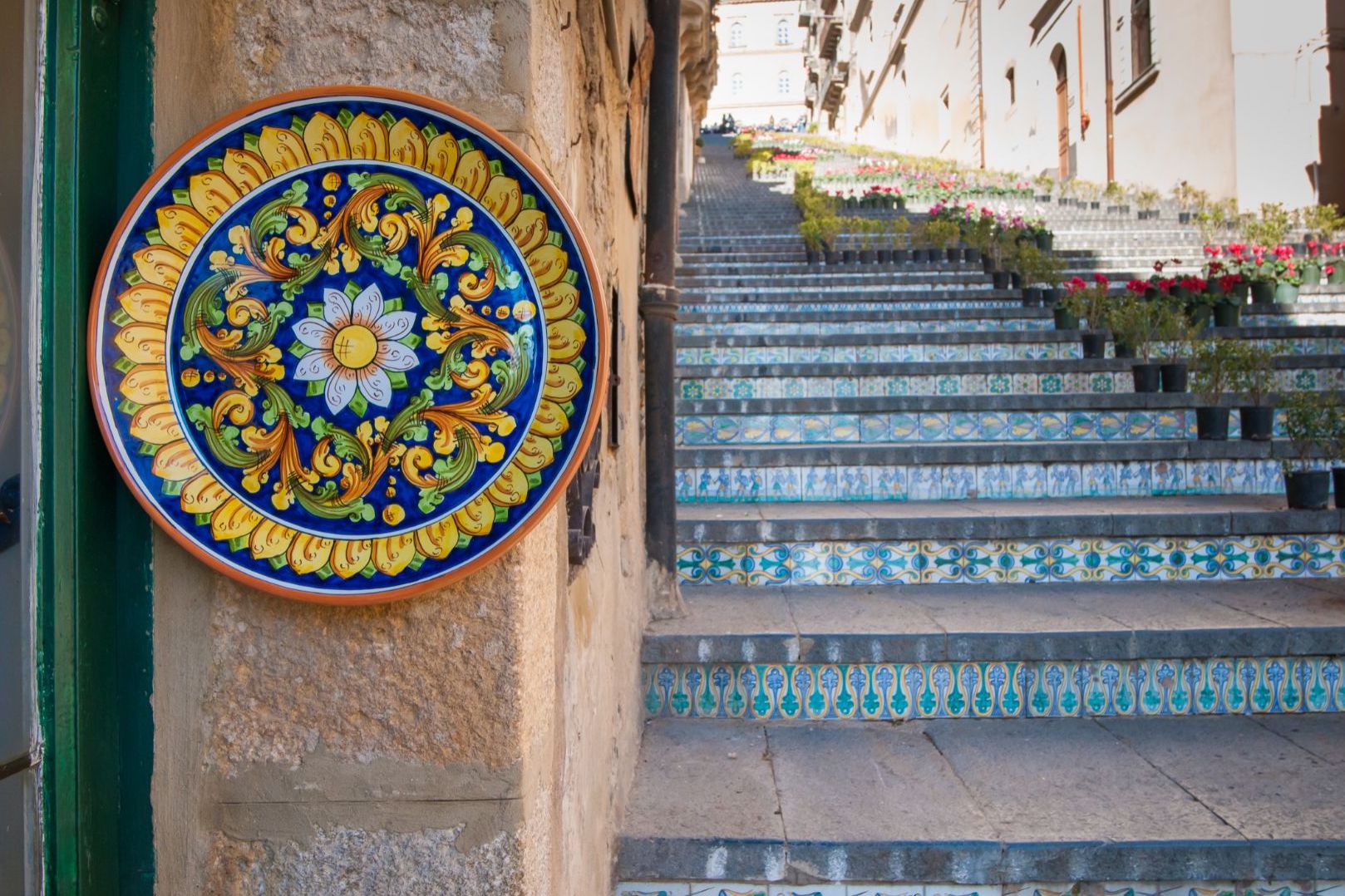
Visiting Caltagirone in one day is easiest when you follow the shape of the town. Begin along Via Roma in the lower city, then walk towards Piazza Municipio, the Santa Maria del Monte Staircase and the upper historic centre. Allow four to five hours for the essential route, or a full day with the ceramics museum, lunch and a private palazzo or artisan workshop. Expect slopes, uneven surfaces and steps.
For a broader introduction before you arrive, explore Caltagirone and its ceramic Baroque.
Caltagirone in one day: the route at a glance
| Plan | Details |
|---|---|
| Time needed | 4–5 hours for the main walk; a full day with a museum, lunch and a booked visit |
| Pace | Mostly on foot, with uphill sections and steps |
| Route | Via Roma → Public Gardens and Ceramics Museum → Ponte San Francesco → Piazza Municipio → Santa Maria del Monte Staircase → palazzo or artisan workshop |
| Book ahead | A private residence, guided visit or ceramic workshop |
| Best for | Ceramics, architecture, photography and slow cultural travel |
If time is limited, choose either the ceramics museum or an artisan workshop. Caltagirone rewards close attention: to a painted tile, a stone courtyard or a potter guiding wet clay.
Start on Via Roma: gardens, viewpoints and ceramics
Via Roma begins among trees, balustrades and open views before the streets tighten around the historic centre.
The Public Gardens and the majolica balustrade
Start at the Giardino Pubblico Vittorio Emanuele II. Morning light moves across the glazed majolica balustrade; the ironwork of the Liberty-style bandstand appears between palms and mature trees. Walk along the edge and notice how ceramics are already part of the urban fabric—in stairs, balconies, façades and street signs.
The Regional Museum of Ceramics
The Regional Museum of Ceramics provides context for the rest of the day, tracing local production from archaeological pieces and everyday objects to architectural decoration. Allow roughly 75–90 minutes if it is a priority; otherwise, reserve the morning for a workshop. Check current opening arrangements before travelling.
Cross Ponte San Francesco into the historic centre
Continue along Via Roma towards the Church of San Francesco d’Assisi all’Immacolata and cross Ponte San Francesco. Behind you are gardens and open views; ahead, the streets become denser and steeper. Civic and religious interiors nearby have variable access, so treat them as possible additions rather than fixed appointments.
Piazza Municipio and the civic palaces
Around Piazza Municipio, Galleria Sturzo, municipal buildings and former civic palaces create a formal rhythm. Look at eye level too: worn stone, iron balconies and ceramic signs set into walls. From here, workshop-lined streets lead towards the staircase. Compare several studios before buying; styles range from traditional ornament to restrained contemporary work.
The Santa Maria del Monte Staircase
The Scalinata di Santa Maria del Monte has 142 steps decorated with majolica tiles. Blue, green and yellow meet pale stone; geometric patterns give way to floral and figurative designs. Climb at your own pace, pause halfway and turn around. The view and side streets show the staircase as a lived part of the town, not an isolated monument.
At the upper end stands the Church of Santa Maria del Monte, in the oldest part of Caltagirone. Church access may vary during services, the midday interval and local celebrations, so keep the plan flexible.
Seasonal flower displays and traditional illuminations sometimes transform the staircase. Dates change, so check the official local calendar before planning around an event.
Add a private palazzo or an artisan workshop
A full day allows you to move beyond the public landmarks and enter one of the spaces where Caltagirone’s material culture is still tangible.
Palazzo Spadaro Libertini
A short walk from the staircase, Palazzo Spadaro Libertini lets you read the historic centre from inside a private residence, through stone, staircases and reception rooms. Visits take place on selected dates or by arrangement. Confirm language and access in advance, and check the guided visit to Palazzo Spadaro Libertini for current details.
How to choose a ceramic workshop
An artisan visit works best when arranged. Ask whether you will meet the maker, see production and discuss how a piece was formed and decorated.
If you are buying something substantial, discuss shipping before payment. Ask for:
- the name of the workshop or maker;
- a detailed receipt;
- suitable protective packaging;
- shipment tracking and insurance options;
- a clear estimate of dispatch and delivery times;
- confirmation of who handles damage or customs questions.
A small tile or bowl with clear provenance can carry more character than an ornate object chosen in haste.
Lunch and the slower part of the day
Plan lunch around booked visits, especially outside the busiest months. Do not assume that kitchens, museums and workshops remain open continuously. Choose a table near the upper town if your afternoon includes the staircase, a palazzo or a studio, and leave enough time before a timed visit.
Practical advice for international travellers
How much time to allow
Four to five hours cover the main route with either the museum or a workshop. Choose a full day for both, plus lunch and a historic residence. Adding another major Baroque town usually reduces Caltagirone to a quick staircase stop.
Getting there and moving through the town
A rental car or private driver offers the greatest flexibility. With public transport, check outward and return schedules for your exact date. Begin near lower Via Roma and finish in the upper town; with a driver, arrange a different pick-up point to avoid retracing the climb. Check current parking and access rules locally.
Walking, steps and accessibility
Expect slopes, stone and stairs beyond the Scalinata itself. Travellers with reduced mobility should arrange transport between the lower and upper town and contact each venue about accessible entrances.
Opening hours and reservations
Museum, church and workshop hours can change by season or holiday. Check official information shortly before visiting and request an English-language guide in advance.
Buying and shipping ceramics
For international shipping, confirm the courier, insurance, packaging and responsibility for breakage in writing. Photograph the piece before packing and keep the receipt and tracking information.
Where Caltagirone fits into a Sicily itinerary
Caltagirone fits naturally between the Catania–Etna area and the Iblean or south-eastern Baroque towns. Here, views stretch over cultivated plains, streets rise sharply, and clay connects domestic objects with churches and public architecture.
The entire old town forms part of UNESCO’s Late Baroque Towns of the Val di Noto. This makes Caltagirone a natural addition when you plan a wider Eastern Sicily itinerary or want to discover Sicily’s inland UNESCO sites.
One night nearby, or a day with a private driver, creates room for the museum, lunch and an appointment with a maker.
Frequently asked questions
Is Caltagirone worth a day trip?
Yes, particularly for ceramics, Baroque architecture and a working town rather than a checklist of monuments. Allow four to five hours, or a full day with museum, lunch and private visit.
Can you see Caltagirone without a car?
Once there, explore the centre on foot. Reaching and leaving by public transport requires planning, so check your date’s timetable first.
How many hours do you need in Caltagirone?
Allow at least four hours for the route and one principal visit; six to eight for the museum, lunch and a palazzo or workshop.
Is the historic centre difficult to walk?
The route includes slopes, uneven paving and steps. Travellers with limited mobility should arrange transfers and confirm accessible entrances.
Do ceramic workshops ship abroad?
Many can, but terms differ. Confirm packaging, insurance, tracking and responsibility for damage before paying.
Should you book Palazzo Spadaro Libertini in advance?
Yes. It is a private residence, so confirm the date, meeting point, language and accessibility arrangements.
The residence can also be opened privately, outside the scheduled dates: a private visit reserved for your own party, with the date and the programme agreed in advance.
