
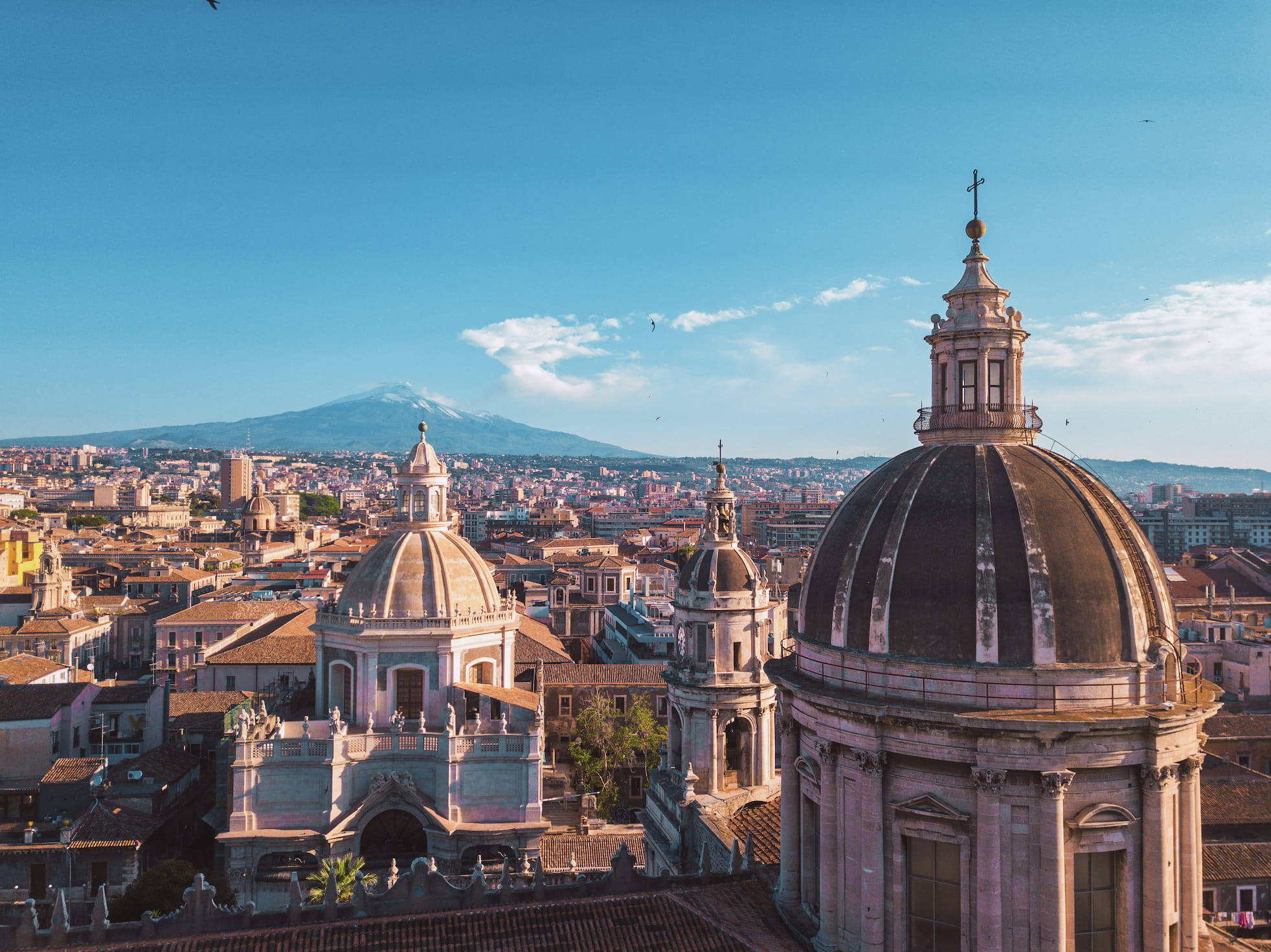
Choosing among luxury hotels near Mount Etna and in Catania is less about finding the “best” property than deciding what kind of Sicily you want around you each morning.
Catania gives you black lava-stone Baroque, markets, restaurants and the energy of a lived-in city. Acireale moves the stay towards the Ionian coast, with more space and a quieter rhythm. Mount Etna changes the journey altogether: vineyards, woodland, wellness hotels and higher-altitude landscapes become part of the day rather than an excursion from somewhere else.
These are not interchangeable bases. The right choice depends on how much time you want to spend in the city, whether you plan to drive, and whether Etna is a day trip or one of the main reasons for travelling.
Where to stay in Catania: three very different bases
For an international traveller, it helps to separate the area into three distinct ways of staying.
Catania city centre is the most practical choice for a first visit, a short stay or the beginning and end of a wider trip through eastern Sicily. Catania Fontanarossa Airport is the principal gateway to this side of the island, which also makes the city useful for a first night after arrival or a final night before departure.
It is worth understanding what Catania is before choosing it. This is not Taormina, and it is not a resort town. It is a working Sicilian city, built in dark volcanic stone, with food markets, universities, offices, palaces and everyday life occupying the same streets. That intensity is part of its appeal.
Acireale and the Ionian coast work differently. Here, the advantage is not being within walking distance of every monument but having more space and a calmer base while remaining connected to Catania and the eastern coast.
Mount Etna is the right choice when the volcano itself is central to the trip. Staying around Linguaglossa or Zafferana Etnea means waking closer to vineyards, mountain roads and the landscapes of the Etna park rather than repeatedly driving up from the coast.
Our selection of Catania and the Baroque Coast brings together the city and coastal stays, while Etna — Wine, Golf & Spa focuses on properties where the volcano becomes part of the stay itself.
There is also a practical distinction that matters more to foreign visitors than it may to Italians: you can enjoy central Catania without a car; for a stay built around Mount Etna, a car or pre-arranged private transport gives you far more freedom.
In the city centre, inside the Baroque
Catania works particularly well for travellers who want culture, restaurants and city life to remain within easy reach.
The centre has a character that is very different from the polished resort atmosphere many visitors associate with Sicily. Its Baroque architecture is built from and framed by volcanic stone. Churches, private palazzi and busy streets sit close together. During the day the city can feel intense; in the evening it becomes easier to read, especially once the heat and traffic begin to fall away.
Evening habits are later than many Northern European or North American visitors expect. Dinner is generally not an early affair, particularly in summer, and a city-centre stay makes that rhythm easier: there is less need to coordinate every evening around a return drive.
Bellini Palace B&B: for staying inside the city
Bellini Palace B&B is 200 metres from Villa Bellini and 1.2 kilometres from Piazza del Duomo.
Its appeal lies primarily in location. This is a stay for travellers who want to step outside and have Catania around them rather than spend much of the day inside a large resort.
For a short city break, or for the first part of a journey before moving towards Etna or the coast, that can be more valuable than an extensive list of on-site facilities.
The logic is straightforward: fewer transfers, easier evenings in the city, and a more immediate relationship with Catania itself.
Airone City Hotel: Catania as a practical base
Airone City Hotel is a four-star hotel close to Catania’s historic centre.
It makes particular sense when Catania is being used not only as a destination but also as a base for exploring eastern Sicily.
Travellers planning to move frequently by car may prefer this kind of position to staying deep inside the most monumental streets of the centre. It allows Catania to remain accessible while making departures towards other parts of the region more straightforward.
The distinction matters: a central stay is about immersion; a well-positioned city base is about balancing the city with the rest of the itinerary.
Palazzo Biscari helps explain why staying in Catania can be worthwhile even when the hotel itself is not the main attraction.
Palazzo Biscari is an eighteenth-century private historic residence occupying an entire block in the Civita district, facing towards the harbour and the Archi della Marina.
In Sicily, the expression historic residence does not necessarily mean a hotel. It can describe a private palace or aristocratic home whose architecture, interiors and family history form part of the island’s cultural heritage. Palazzo Biscari is one of those places: it can be visited, but it is not somewhere you book a room.
That distinction is useful. Staying in the centre is not only about convenience; it also places you close to buildings that explain Catania’s identity.
For travellers who want to experience this side of Sicily more privately, a private visit to a Sicilian historic house can extend that perspective beyond the usual museum visit.
In Acireale: space, and a different pace on the Ionian coast
Moving towards Acireale changes the balance of the stay.
You give up some of the immediacy of central Catania, but gain space, a more residential atmosphere and easier access to a different stretch of the Ionian coast.
This is generally a more convincing choice for travellers with a car and for longer stays where every day does not need to begin with a walk through the city centre.
Villa Arianna: privacy and more room to settle in
Villa Arianna is in Acireale, 19 kilometres from Piazza del Duomo in Catania.
The villa contains two apartments, each with living space, bedroom, kitchenette and terrace overlooking the garden. There is also a seasonal outdoor swimming pool.
Those details immediately suggest a different kind of stay from a central hotel.
Villa Arianna is not the logical choice for someone whose priority is walking to Catania’s monuments every morning. It becomes more interesting for travellers who want greater independence, more living space and the possibility of alternating days out with time spent at the property.
For couples or travellers staying longer, that flexibility can be more valuable than proximity to a particular square.
Acireale also works as a middle ground. You remain on the eastern side of Sicily, within reach of Catania, but the atmosphere is less urban and the trip can be paced more slowly.
Here, having a car becomes much more important. Unlike central Catania, the advantage is not eliminating transport but using the property as a comfortable base from which to move selectively.
On Mount Etna: park, wine and wellbeing
For many international visitors, Mount Etna appears first as a day trip from Catania or Taormina.
That works when time is limited. But staying on or around the volcano creates a very different experience.
The landscape changes with altitude. Summers are generally cooler than on the coast, while winter can bring genuinely cold conditions and snow at higher elevations. The mountain therefore has its own seasonal rhythm; packing and planning for Etna as though it were simply another coastal destination is a mistake.
Travel distances also feel different once you leave the city. From central Catania to Rifugio Sapienza, for example, the drive is around 45 minutes in normal conditions. Other Etna destinations lie on different slopes and require different routes.
The result is simple: if wine, walking, landscape and the volcano itself are central to the trip, staying closer to Etna often makes more sense than commuting from Catania every day.
Villa Neri Resort & Spa: staying near Linguaglossa
Villa Neri Resort & Spa is a five-star property near Linguaglossa, within the Etna park.
Linguaglossa is one of the names international travellers increasingly encounter when researching where to stay around Mount Etna. It sits on the northern side of the volcano, in a landscape shaped by lava, woodland and vineyards.
The important point is not simply that Villa Neri is “near Etna”. It allows the volcano to become the setting of the stay rather than somewhere visited for a few hours before returning to the city.
With a swimming pool, restaurant and wellness facilities, it also works for travellers who want to balance time exploring the territory with time spent at the property.
For a couple planning several nights around Etna, this can produce a more coherent journey than using Catania as a base for repeated return trips.
Il Pìcciolo Etna Golf Resort & SPA: altitude, golf and landscape
Il Pìcciolo Etna Golf Resort & SPA occupies a historic country residence at approximately 650 metres above sea level on the slopes of Mount Etna.
The altitude is not merely a number. It affects the atmosphere of the stay, particularly outside high summer, and reinforces the sense that this is no longer a coastal holiday.
Golf and wellness also change the daily rhythm. Not every day needs to be structured around sightseeing. Time at the resort can form part of the trip rather than feeling like time taken away from Sicily.
This type of property is particularly suited to longer itineraries, travellers combining several parts of eastern Sicily, or anyone for whom the landscape surrounding the hotel matters as much as its distance from Catania.
Airone Wellness Hotel: staying near Zafferana Etnea
Airone Wellness Hotel is located within the Etna Regional Park, near Zafferana Etnea, and includes a panoramic swimming pool and wellness centre.
Zafferana lies on the eastern side of Etna and represents a different geographical reference point from Linguaglossa on the north.
For travellers unfamiliar with the volcano, these village names matter because “staying near Mount Etna” can mean very different things depending on the slope.
The wine landscape is part of that distinction.
Etna is not simply volcanic scenery; it is also one of Sicily’s most distinctive wine territories. Etna DOC vineyards climb the slopes at different altitudes and exposures, and the northern and eastern sides of the volcano develop their own identities.
For a visitor who knows Barolo but not yet Nerello Mascalese, the useful idea is not that the wines are similar. It is that Etna, too, is a place where grape variety, altitude, lava soils and individual slopes matter enormously.
This is why wine works best here when it is treated as part of the territory rather than as an isolated tasting. A private Etna wine tour can connect vineyards, landscape and the geography of the volcano in a way that is difficult to understand from the coast.
For a stay around Zafferana or Linguaglossa, that experience fits naturally into the journey.
Which zone suits which trip
The simplest way to choose is to begin with the trip rather than the hotel.
For a first visit to Catania, especially for two or three nights, staying in or close to the city centre is usually the most straightforward option. You can experience the city without depending on a car and organise Etna separately if needed.
For an arrival or departure night, Catania also has a practical advantage because of its relationship with Fontanarossa Airport. There is little value in adding a long transfer on the first evening if the following day already involves driving elsewhere.
For a longer stay with a car, Acireale becomes more interesting. You gain space and autonomy while keeping the city within reach.
For a trip centred on wine, landscape, wellness or outdoor time, staying around Mount Etna is the stronger choice. It avoids turning the volcano into a repeated commute and allows each day to begin much closer to the places you actually intend to explore.
For summer, the higher elevations around Etna can offer a noticeably different atmosphere from the coast. In autumn and winter, wellness facilities, internal restaurants and the character of the property itself become more important, while mountain weather deserves greater attention.
And if the real decision is not Catania versus Etna but Taormina versus Etna, that is a different question. We treat it separately in our guide to staying in Taormina or near Mount Etna.
The principle remains the same: do not select the hotel in isolation. Select the geography first.
Frequently asked questions
Do I need a car to stay near Mount Etna?
For most stays built around Mount Etna, a car is the easiest option.
Hotels, wineries, villages and walking areas are spread across different slopes, and public transport does not provide the same flexibility you would have in a city centre.
If you prefer not to drive, private transfers and pre-arranged experiences can make the journey work, but they should be organised as part of the itinerary rather than left until arrival.
In central Catania, by contrast, a car is not essential for the city itself and can sometimes be more inconvenience than advantage.
How far is Mount Etna from Catania?
It depends on which part of the volcano you mean.
Mount Etna covers a large area and there is no single “Etna” arrival point. As a useful reference, the drive from central Catania to Rifugio Sapienza is around 45 minutes in normal conditions.
Linguaglossa, Zafferana Etnea and the wine estates on different slopes follow different routes, so journey planning should be based on the actual destination rather than the volcano as a generic point on the map.
Should I stay in Catania or Taormina?
They serve different trips.
Catania is a real, busy city with Baroque architecture, markets, restaurants and strong transport connections. Taormina is smaller, more scenic and more explicitly geared towards visitors.
If Mount Etna is central to the trip, neither should automatically win: spending part of the journey closer to the volcano can be more rewarding than choosing one coastal base for the entire stay.
For the specific Taormina–Etna decision, see the separate comparison linked above.
What is Mount Etna like in winter?
Winter on Etna should not be imagined as a milder version of the Sicilian coast.
Altitude changes the conditions significantly. Higher areas can receive snow, temperatures can fall sharply and weather may affect access to parts of the mountain.
That does not make winter a poor time to stay. It simply changes the experience. Hotels with wellness facilities, restaurants and comfortable interiors become more important, and the landscape can be particularly atmospheric.
Always check current mountain and road conditions close to the date of travel.
How many days should I spend between Catania and Mount Etna?
For a short eastern Sicily trip, two nights in Catania plus two or three around Etna can create a useful contrast without excessive moving.
For a longer journey, the split should depend on priorities. Travellers interested primarily in architecture, food and city life may want more time in Catania. Those planning wineries, walking, golf or wellness will usually benefit from giving Etna more than a single day.
What matters is avoiding an itinerary in which every day becomes a long return transfer.
Choosing the stay around the journey
Catania, Acireale and Mount Etna can belong to the same itinerary, but they do not offer the same version of Sicily.
Choose the city when culture, restaurants and ease of arrival matter most. Choose Acireale when you want greater space and independence. Choose Etna when the volcano, wine landscape and time spent at the property are part of the reason for travelling.
Sicily Luxury can help narrow the options according to your dates, number of guests and preferred pace of travel.
Request a curated stay in Sicily.
