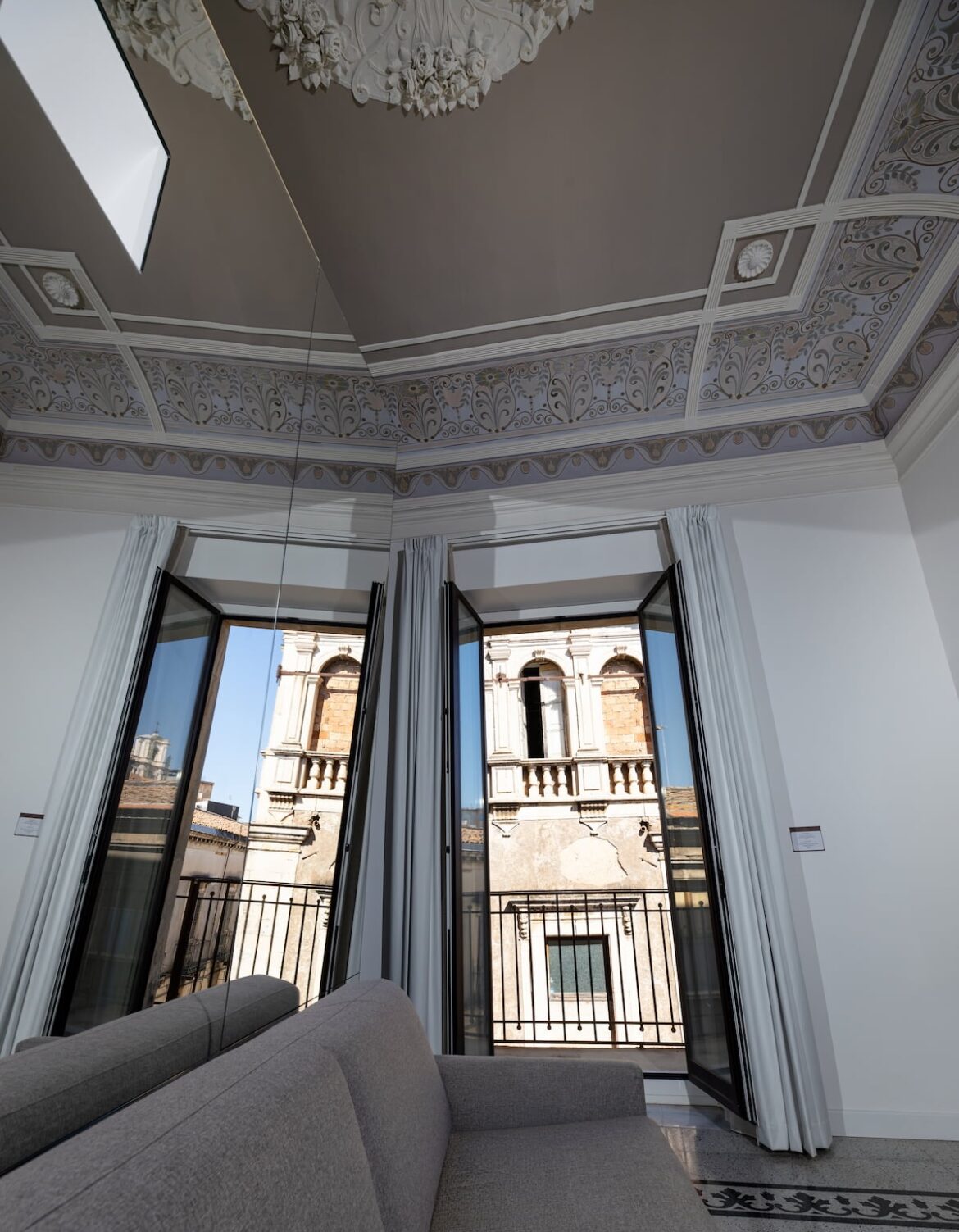
A few minutes above the Santa Maria del Monte Staircase stands Palazzo Spadaro Libertini. It is not a museum: no ticket office, no fixed circuit, no rope along the walls. It is a private house that opens its main rooms by arrangement, and the damasks on those walls are the original ones — not replacements, not reproductions.


Position
A private residence in the heart of Caltagirone
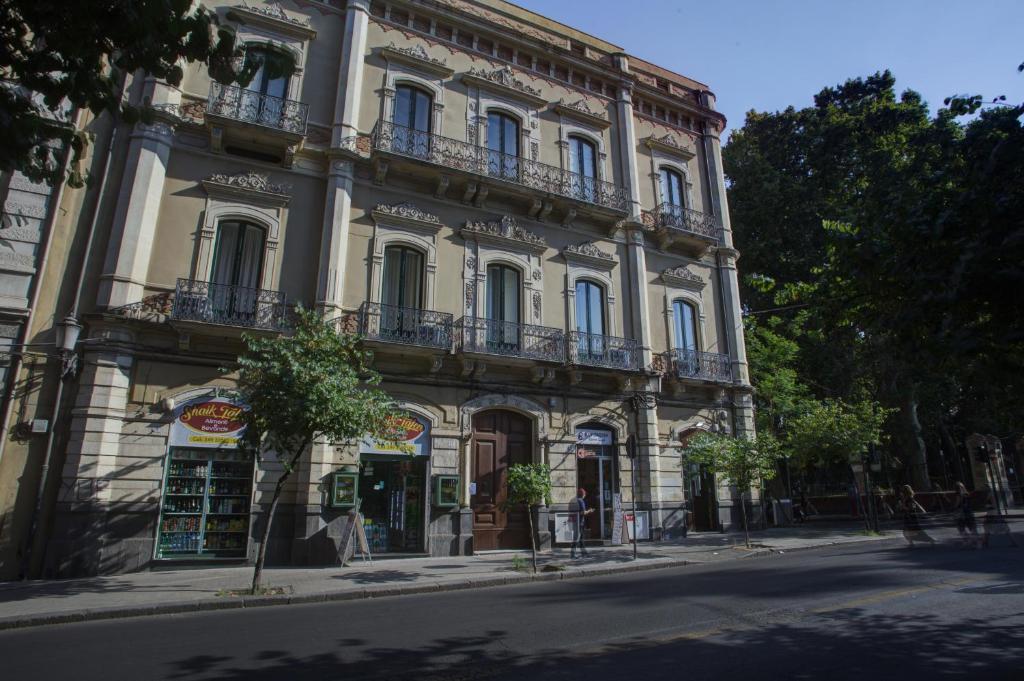
The address is Via San Bonaventura 22, a short walk from the majolica Staircase and beside the seventeenth-century church of San Bonaventura, which came through the 1693 earthquake intact.
There is a second way in, and it is the more surprising one: the palace also opens onto the carruggi, the steep alleys climbing alongside the Staircase, at Via Bonanno 1. The word is Genoese: local tradition traces it to a Genoese presence in the town in the eleventh century. Whatever its origin, it stuck — the inhabitants still call their alleys carruggi, tangled like a casbah.
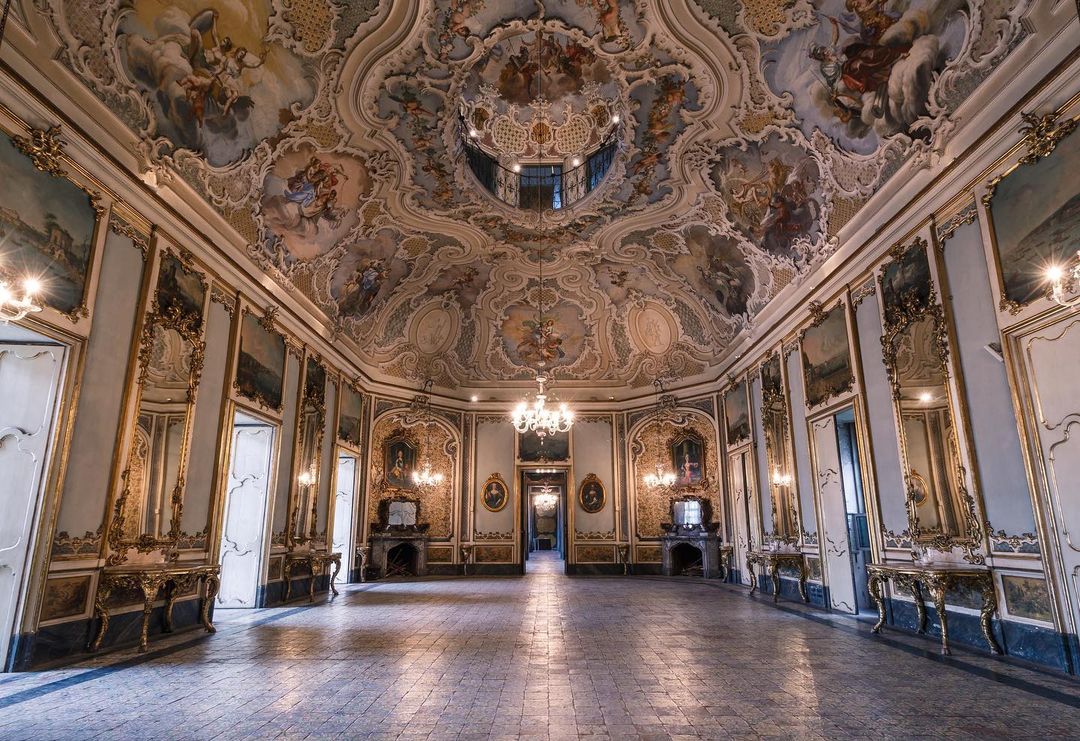
The State Rooms
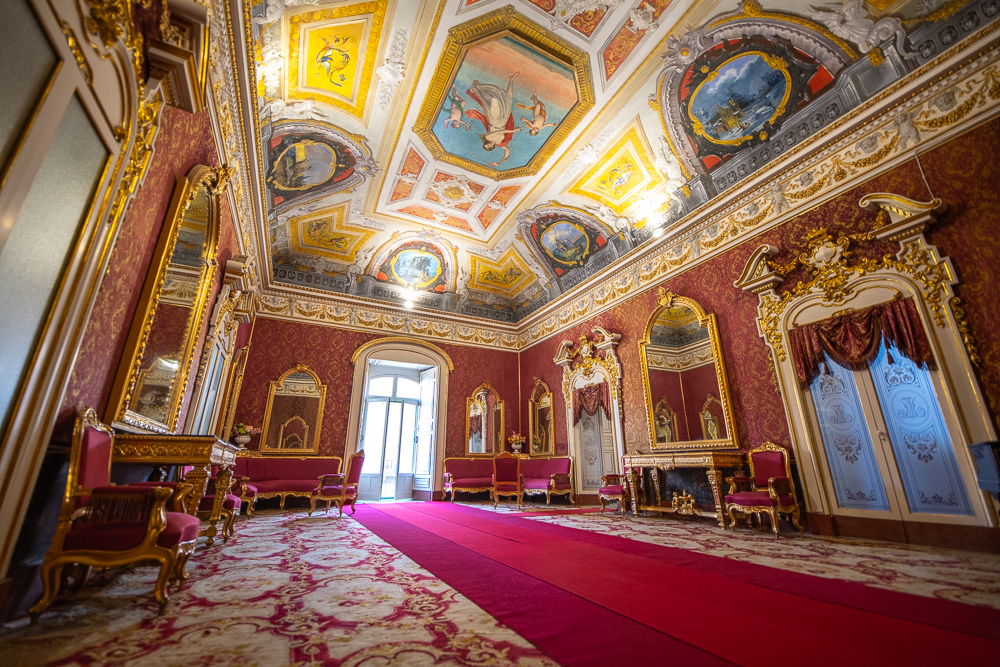
The reception floor holds five rooms, each named for what it is made of or covered in: Coats of Arms, Marbles, the Yellow Salon, the Mirror Room — also called the Red Room — and the Blue Salon. The vaults carry work by Francesco Vaccaro, of the Calatino family of artists whose paintings hang in churches and museums from Caltagirone to the Ragusa area. The doors are glass, painted with exotic animals and flowers that pick up the motifs overhead.
In the Mirror Room there is a Pleyel Wolff grand piano of around 1865, ordered from Paris so the rooms could be used for music. Conservation took over a year; strings, hammers and ivory keyboard are all original, and it is tuned slightly below today’s 440 Hz — low enough to be played in concert. The house records that Wagner played it, on a visit from Ramacca.
Damasks, carpets and furnishings
The damasks in these rooms were never replaced. The Yellow Salon’s gold damask needed no intervention at all. The Mirror Room keeps its red silk woven with gold thread, worked into flowers, leaves and garlands. The Blue Salon holds the oldest, early eighteenth century, in two shades of blue shot through with silver, restored with the least possible intervention rather than made to look new. The rest came from France: lacquered fixtures in white and gold, furniture, and Aubusson carpets commissioned for the specific rooms they were meant for.
Layers of history
The palace stands on a sixteenth-century foundation, the unfinished house of Bonaventura Secusio, born here in 1558 and later bishop of Catania. After the 1693 earthquake the fragments of several buildings were pulled into one: reconstruction began in 1725 under Barbaro Maggiore, Marchese di Santa Barbara, and finished in 1732.
In 1871 most of it passed to Michelangelo Libertini of the Barons of San Marco, who made the reception floor his own and furnished it from France. His son Gesualdo, a Senator of the Kingdom of Italy, had no direct heirs and left everything to his nephew Francesco Spadaro di Passanitello, historian and mayor of Caltagirone. Hence the double name.
These rooms were used for talking as much as for entertaining: around 1768 they hosted the Arcadian Colony, and a century later they were Senator Libertini’s political salon. Luigi Capuana, the theorist of Italian Verismo, once asked the baron for political backing; a copy of his letter of thanks is on display.
Declared a monument of significant artistic interest in 2001, the palace was then restored: the art historian Alvise Spadaro di Passanitello Gravina passed the reception wing to his cousin Lara Marina Gravina di Belmonte, who took it on with her mother Gemma. The ceramics belong to the same work — antique riggiole from the buildings merged after 1693, shown alongside modern pieces by Caltagirone master ceramists.
The “Castello” entrance and the hypogeum
Below and behind the reception floor the building gets older and plainer. The entrance known as the Castello is the medieval part: arches, vaults, worked stone, no decoration to speak of. Underneath lies the hypogeum, a set of underground rooms. The first floor belongs to the same buried history and has only recently been brought back.
A legend that survived
On 7 and 8 February 1799, nobles, magistrates and priests suspected of Jacobin sympathies were seized and killed in the square before the cathedral of San Giuliano. Before fleeing the city, the nephew of Marchese Barbaro Maggiore di Santa Barbara is said to have buried candelabra and silver inside the palace. He never returned, and nothing was ever found.
Visiting
The State Rooms, the Castello entrance and the hypogeum can be seen on a guided route, by reservation. Prices, availability, languages, meeting point and accessibility are all kept on the page dedicated to the visit, which is the one to check before you go.
The reception floor is also used for concerts, exhibitions, conferences and photographic and film shoots.
If you are building a day around it, our walking itinerary through Caltagirone places the palace among the rest of the historic centre.
Profile IG @palazzospadarolibertini